1. Introduction to Life Processes
Is breathing the same as being alive? Not by itself — machines also move, and a seed stays still for months yet is very much alive. Living organisms are recognised by a set of characteristic activities that they keep performing as long as they are alive.
Life processes are the basic functions that an organism carries out to stay alive, to grow, and to keep its body working. They include nutrition, respiration, transportation, and excretion.
These processes maintain a living body in a controllable, near-constant internal state. Food supplies fuel and building material; respiration releases energy from that food; transportation carries substances to and from every cell; and excretion removes waste that would otherwise poison the body.
Cells continually need energy to repair themselves, to grow, and to carry out their jobs. Raw materials must enter the body, useful substances must reach every cell, and waste must leave. Without these inter-linked processes, cells cannot survive — so the whole organism dies.
The four major life processes
- Nutrition – taking in food and breaking it down so it can be used by the body.
- Respiration – releasing energy from glucose, usually by reacting it with oxygen.
- Transportation – moving food, oxygen, water and waste around the body.
- Excretion – removing waste products produced in the body.
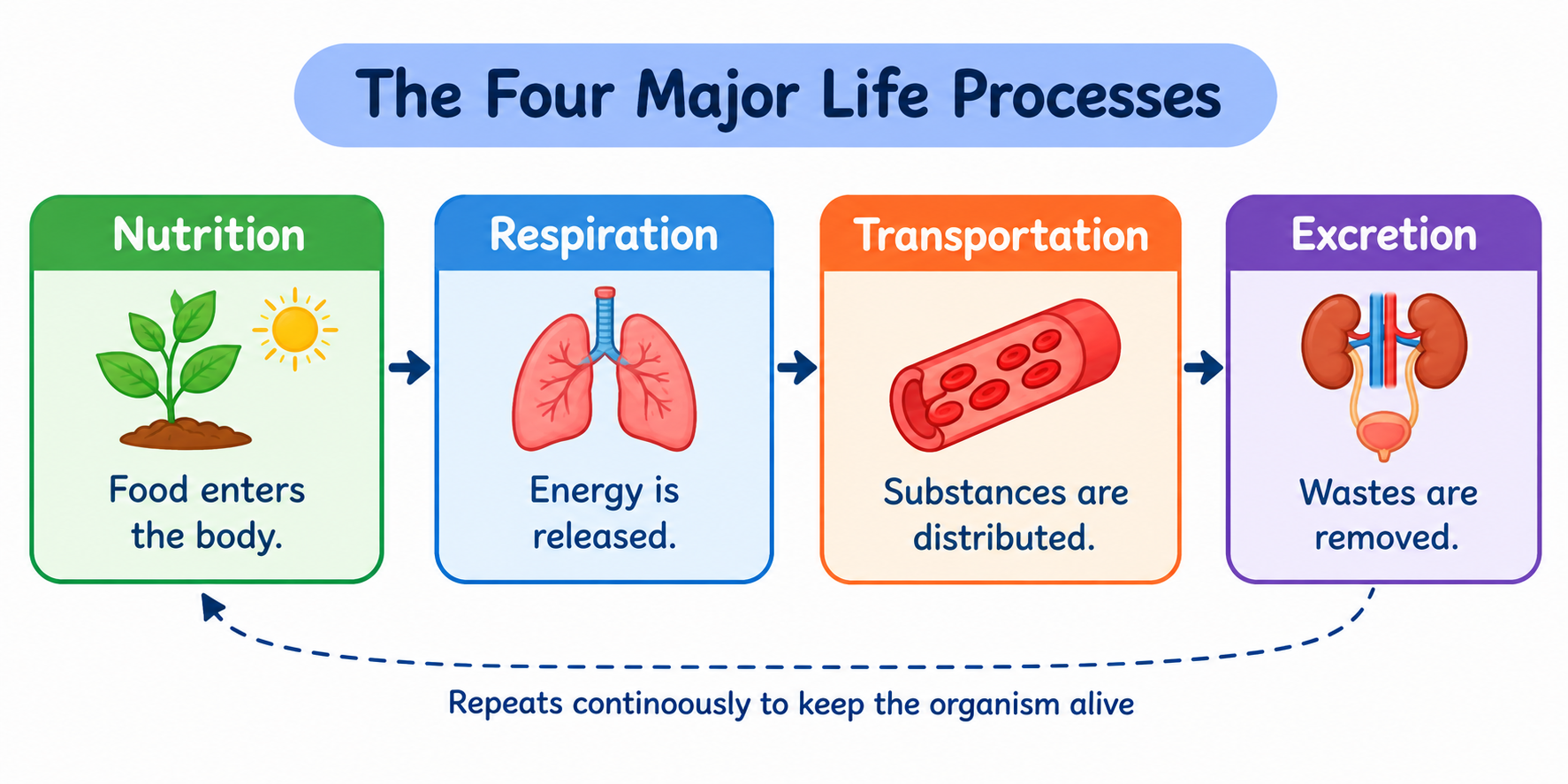
Remember the chain: Nutrition feeds, Respiration energies, Transport delivers, Excretion cleans. Together they are "NRTE" — our body’s daily engine cycle.
2. Nutrition – Autotrophic and Heterotrophic
All living things need food. Food supplies the energy for life and the raw materials the body uses to build and repair itself.
Nutrition is the process of taking in food, breaking it down to simpler molecules, and absorbing the useful parts so the body can use them for energy, growth and repair.
Two main modes of nutrition
- Autotrophic nutrition – organisms make their own food from simple inorganic substances using light energy. Example: green plants.
- Heterotrophic nutrition – organisms depend on other organisms (or their remains) for food. Examples: animals, fungi, most bacteria.
| Feature | Autotrophic nutrition | Heterotrophic nutrition |
|---|---|---|
| Source of food | Makes its own food | Takes food from others |
| Raw materials | Simple inorganic (CO₂, H₂O) | Complex organic food |
| Energy needed | Uses sunlight (photosynthesis) | No light needed |
| Examples | Green plants, some bacteria | Animals, fungi, many bacteria |
A green vine on your wall makes its own food by photosynthesis (autotrophic), but a mushroom growing beside it feeds on decaying matter in the soil (heterotrophic/saprophytic).
3. Photosynthesis
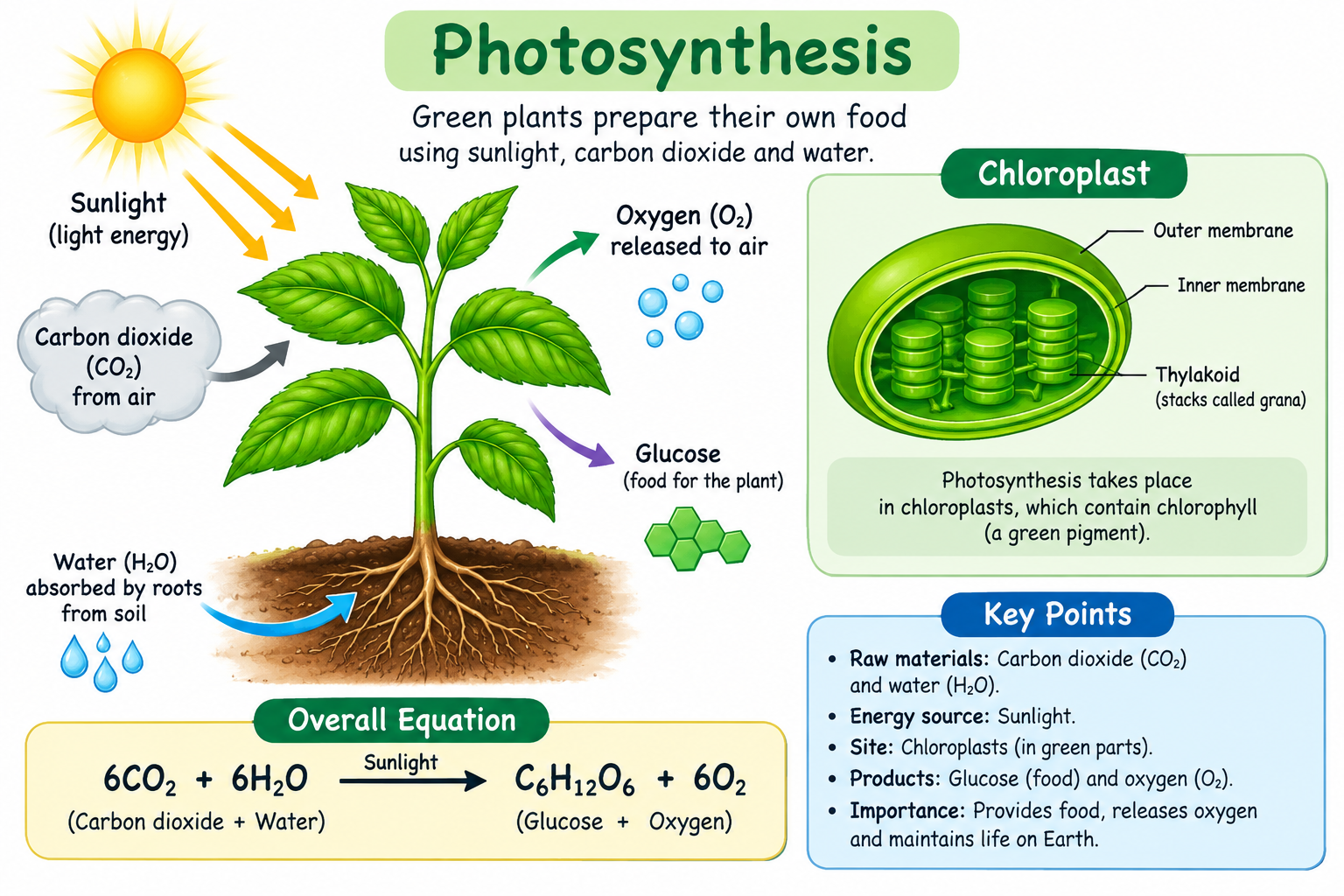
Photosynthesis is how green plants make their own food. It is the largest-scale chemical factory on the planet — nearly all life depends on the glucose plants prepare here.
Photosynthesis is the process by which green plants, using chlorophyll and sunlight, convert carbon dioxide and water into glucose and oxygen.
\[ 6CO_2 + 6H_2O \xrightarrow[\text{chlorophyll}]{\text{sunlight}} C_6H_{12}O_6 + 6O_2 \]
Raw materials required for photosynthesis
- Carbon dioxide (CO₂) – absorbed from the air through stomata.
- Water (H₂O) – absorbed by roots and carried up through the xylem.
- Sunlight – supplies the energy for the reaction.
- Chlorophyll – the green pigment that traps light energy.
Role of chlorophyll
Chlorophyll is present mainly in the mesophyll cells of leaves. It is a pigment that absorbs sunlight and converts it into chemical energy. The leaves therefore act as the solar panels of the plant — the light energy captured here drives the whole reaction.
Role of sunlight
Sunlight supplies the energy needed to split water molecules and join carbon atoms into glucose. Without light through chlorophyll, the reaction cannot take place. This energy gets stored in the chemical bonds of glucose and is released later during respiration.
Stomata and gaseous exchange
Leaves have stomata — tiny pores, usually on the lower surface. They open and close with guard cells and perform three jobs:
- Letting CO₂ in for photosynthesis.
- Letting O₂ out (and CO₂ out during respiration at night).
- Releasing water vapour (transpiration).
Important factors affecting photosynthesis
- Light intensity – more light generally speeds up photosynthesis up to a limit.
- Carbon dioxide concentration – more CO₂ in the air speeds it up until another factor limits it.
- Water availability – shortage of water slows photosynthesis (wilting plants close stomata).
- Temperature – moderate warm temperatures help the enzymes involved; very high temperatures slow or stop them.
- Chlorophyll – green plants need chlorophyll; without it, no photosynthesis.
Photosynthesis occurs mainly in leaves, but it can also occur in green stems (like cactus) and, rarely, in other parts that contain chlorophyll. Only the green parts carry it out.
Modes of heterotrophic nutrition
- Holozoic nutrition – taking in solid food, digesting and absorbing it. Example: humans, amoeba, cattle.
- Saprophytic nutrition – feeding on dead and decaying matter, with digestion outside the body. Example: fungi (mushrooms, mould), bread mould.
- Parasitic nutrition – feeding on a living host, usually harming it. Example: cuscuta (amarbel), tapeworm, lice.
- Symbiotic / lichens – two organisms live together and both benefit; a lichen is a fungus and an alga living together.
| Mode | Food source | Example |
|---|---|---|
| Saprophytic | Dead and decaying organic matter | Fungi, bread mould |
| Parasitic | Living host (harms it) | Cuscuta, tapeworm |
| Holozoic | Whole or partly digested food of other organisms | Human, amoeba, dog |
| Symbiotic | Mutual benefit: both partners gain | Lichen (alga + fungus) |
Amoeba is a unicellular animal. It uses pseudopodia (false feet) to engulf food by a process called endocytosis (phagocytosis). The food goes into a food vacuole where digestive enzymes break it down; useful material is absorbed and waste is thrown out.
4. Human Digestive System
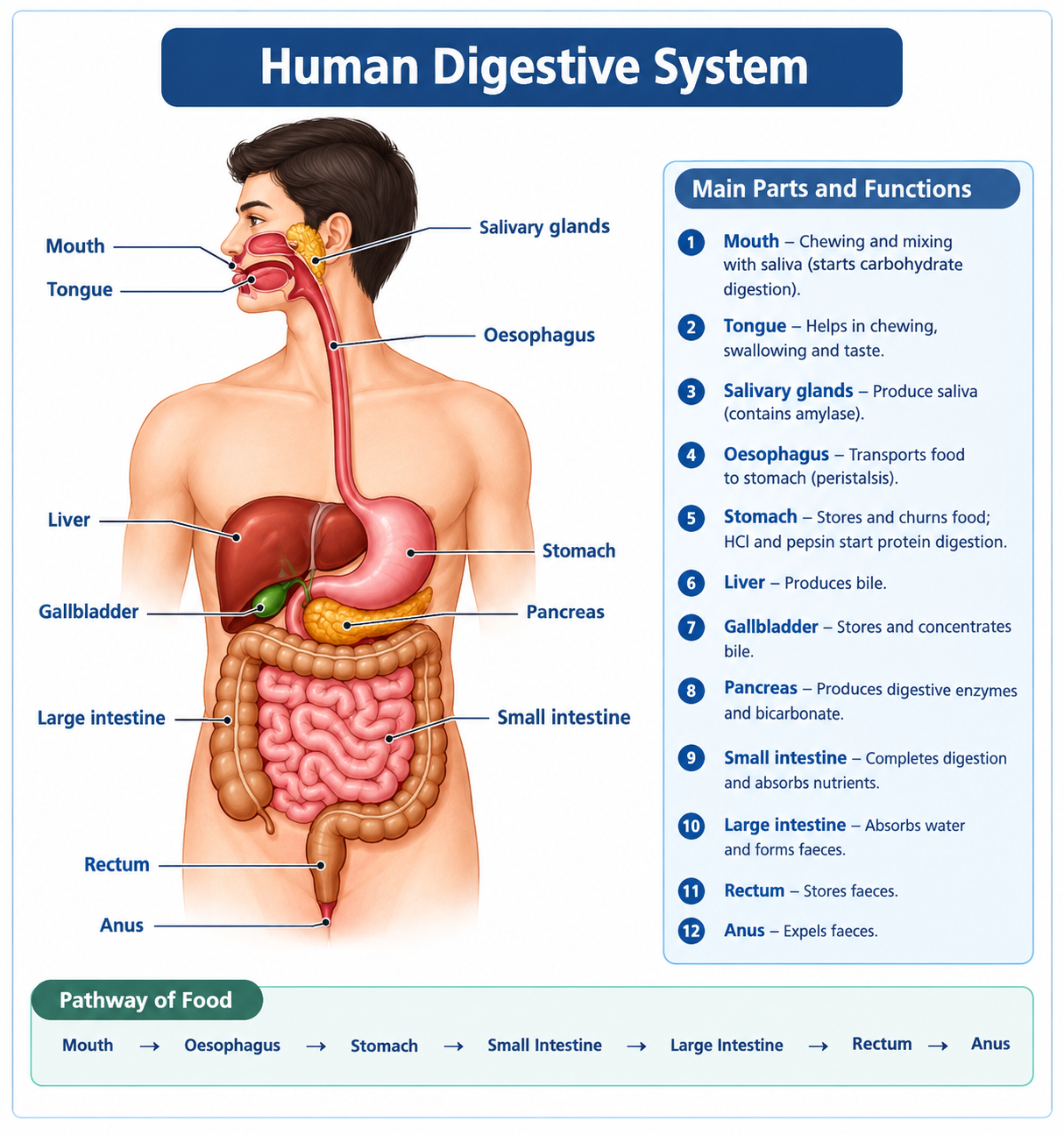
Humans take in complex food containing carbohydrates, proteins and fats. The digestive system breaks this food into small, absorbable molecules in a long tube called the alimentary canal.
Mouth → Oesophagus → Stomach → Small Intestine → Large Intestine → Rectum → Anus
Digestion is the breakdown of large, insoluble food molecules into small, soluble molecules that can be absorbed and used by the body. It involves mechanical breakdown (chewing, churning) and chemical breakdown (enzymes, acids).
Mouth, teeth and tongue
Digestion begins here. Teeth cut and crush food into small pieces (mechanical digestion). The tongue mixes the food with saliva and helps roll it into a soft ball (bolus) for swallowing.
Salivary glands in the mouth release saliva. Saliva contains salivary amylase, an enzyme that begins the breakdown of starch (carbohydrates) into maltose. If an iodine-tested starch solution is mixed with saliva, the blue-black colour fades slowly, showing starch is being broken down.
Oesophagus and peristalsis
The oesophagus is a muscular tube connecting the mouth to the stomach. The food bolus is pushed down by peristalsis — the rhythmical, wave-like squeezing (contraction and relaxation) of the muscles of the food pipe.
Peristalsis is the wave of muscular contraction and relaxation that pushes food (or any substance) along the alimentary canal and other tubular organs.
Stomach
The stomach is a J-shaped muscular bag. Its wall churns and mixes food with digestive juices.
- Hydrochloric acid (HCl) – creates an acidic medium for pepsin to act, and kills many germs that enter with food.
- Pepsin – an enzyme that digests proteins into smaller peptides; it works best in an acidic medium.
- Mucus – protects the stomach lining from its own HCl.
Small intestine
The small intestine is the longest part of the canal and the main site of digestion and absorption. Three juices act here:
- Bile (from liver, stored in gall bladder) – emulsifies fats, making them small droplets for easier digestion. It does not contain enzymes.
- Pancreatic juice (from pancreas) – contains enzymes that digest carbohydrates (pancreatic amylase), proteins (trypsin) and fats (lipase).
- Intestinal juice (from the intestinal walls) – completes the digestion of carbohydrates, proteins and fats into glucose, amino acids and fatty acids + glycerol.
Carbohydrates → glucose; Proteins → amino acids; Fats → fatty acids and glycerol. All three end products are small, soluble molecules ready for absorption.
Villi and absorption
The inner surface of the small intestine has millions of finger-like projections called villi. They greatly increase the surface area for absorption. Each villus has blood capillaries and a lymph vessel (lacteal).
Absorption is the passage of digested food molecules through the intestinal wall into the blood (or lymph). Glucose and amino acids enter the blood; fatty acids and glycerol form tiny droplets absorbed into lymph.
Large intestine, rectum and anus
Undigested residue moves into the large intestine, where water and some minerals are reabsorbed. The remaining solid waste is stored in the rectum and removed through the anus as faeces.
Assimilation is the use of absorbed food molecules by the body — glucose is used for energy, amino acids to build proteins and repair cells, and fats for energy storage and cell membranes.
Keep the sequence and the matching gland in mind: saliva (mouth) → HCl + pepsin (stomach) → bile (liver) → pancreatic juice (pancreas) → intestinal juice (intestine).
5. Respiration
Food contains stored energy in the form of chemical bonds. Respiration unlocks that energy so the cell can use it.
Respiration is the process by which organisms release energy from glucose (food) inside their cells, usually using oxygen. The energy is stored temporarily in a molecule called ATP.
Breathing is the physical exchange of gases (O₂ in, CO₂ out) between the organism and the air. Respiration is a chemical process inside cells that releases energy. Breathing is only the first step of the whole process of respiration in some organisms.
| Feature | Breathing | Respiration |
|---|---|---|
| Nature | Physical process (gas exchange) | Chemical process (releases energy) |
| Where | Lungs / gills / skin | Inside cells (mitochondria) |
| Involves | Inhaling and exhaling air | Breakdown of glucose with O₂ |
| Energy | No energy is released | Energy is released as ATP |
| Enzymes | Not needed | Enzymes are needed |
Aerobic respiration
When glucose is broken down completely using oxygen, maximum energy is released. This is the usual mode for most organisms, including humans at rest.
\[ C_6H_{12}O_6 + 6O_2 \to 6CO_2 + 6H_2O + \text{Energy (ATP)} \]
Glucose + oxygen → carbon dioxide + water + energy. (38 ATP molecules are formed per glucose.)
Anaerobic respiration
When glucose is broken down without oxygen, much less energy is released and the end products differ — still containing energy.
Anaerobic respiration is the breakdown of glucose without oxygen, releasing much less energy. In yeast it makes ethanol and carbon dioxide; in muscle cells (during heavy exercise) it makes lactic acid.
Anaerobic respiration in yeast
\[ C_6H_{12}O_6 \to 2C_2H_5OH + 2CO_2 + \text{Energy (few ATP)} \]
Yeast breaks glucose into ethanol and carbon dioxide. This process is used in making bread (the CO₂ makes it rise) and in brewing and baking.
Anaerobic respiration in muscles (during heavy exercise)
\[ C_6H_{12}O_6 \to 2\, C_3H_6O_3 \,+ \text{Energy (few ATP)} \]
When oxygen is insufficient during vigorous activity, muscles respire anaerobically and produce lactic acid. Accumulation of lactic acid causes muscle cramps and fatigue. The cramps ease when the body gets enough oxygen again to break the lactic acid down.
During heavy exercise the oxygen reaching the muscles is not enough for complete aerobic respiration. Muscles switch to anaerobic respiration, forming lactic acid. This lactic acid accumulates in the muscle, causing cramps and a burning feeling. A short rest (or deep breathing) supplies fresh oxygen, and the lactic acid is slowly removed or converted back.
Breakdown of glucose – the complete story
Glucose (C₆H₁₂O₆) first splits into pyruvate (C₃H₄O₃) in the cytoplasm. The fate of pyruvate then depends on oxygen:
| Step / condition | Where | Products | Energy |
|---|---|---|---|
| Glycolysis (glucose → pyruvate) | Cytoplasm | 2 pyruvate | Small (2 ATP) |
| Aerobic (with O₂) | Mitochondria | CO₂ + H₂O | Much larger (38 ATP) |
| Anaerobic – yeast | Cytoplasm | Ethanol (C₂H₅OH) + CO₂ | Small |
| Anaerobic – muscle | Cytoplasm | Lactic acid (C₃H₆O₃) | Small |
Role of mitochondria
Mitochondria are the powerhouses of the cell. They contain enzymes for complete aerobic breakdown of pyruvate into CO₂ and H₂O, releasing the maximum energy. Cells with high energy needs (muscle, brain) have many mitochondria.
| Feature | Aerobic respiration | Anaerobic respiration |
|---|---|---|
| Oxygen | Required | Not required |
| Sites | Cytoplasm + mitochondria | Only cytoplasm |
| End products | CO₂, H₂O | Ethanol + CO₂ or lactic acid |
| Energy | Large (38 ATP) | Small (2 ATP) |
| Speed | Full breakdown | Partial breakdown |
| Where seen | Most living cells | Yeast, bacteria, muscle cells |
Both aerobic and anaerobic respiration start with glycolysis in the cytoplasm. Aerobic respiration completes the breakdown inside mitochondria with O₂; anaerobic does not use O₂ and ends with ethanol or lactic acid.
6. Human Respiratory System
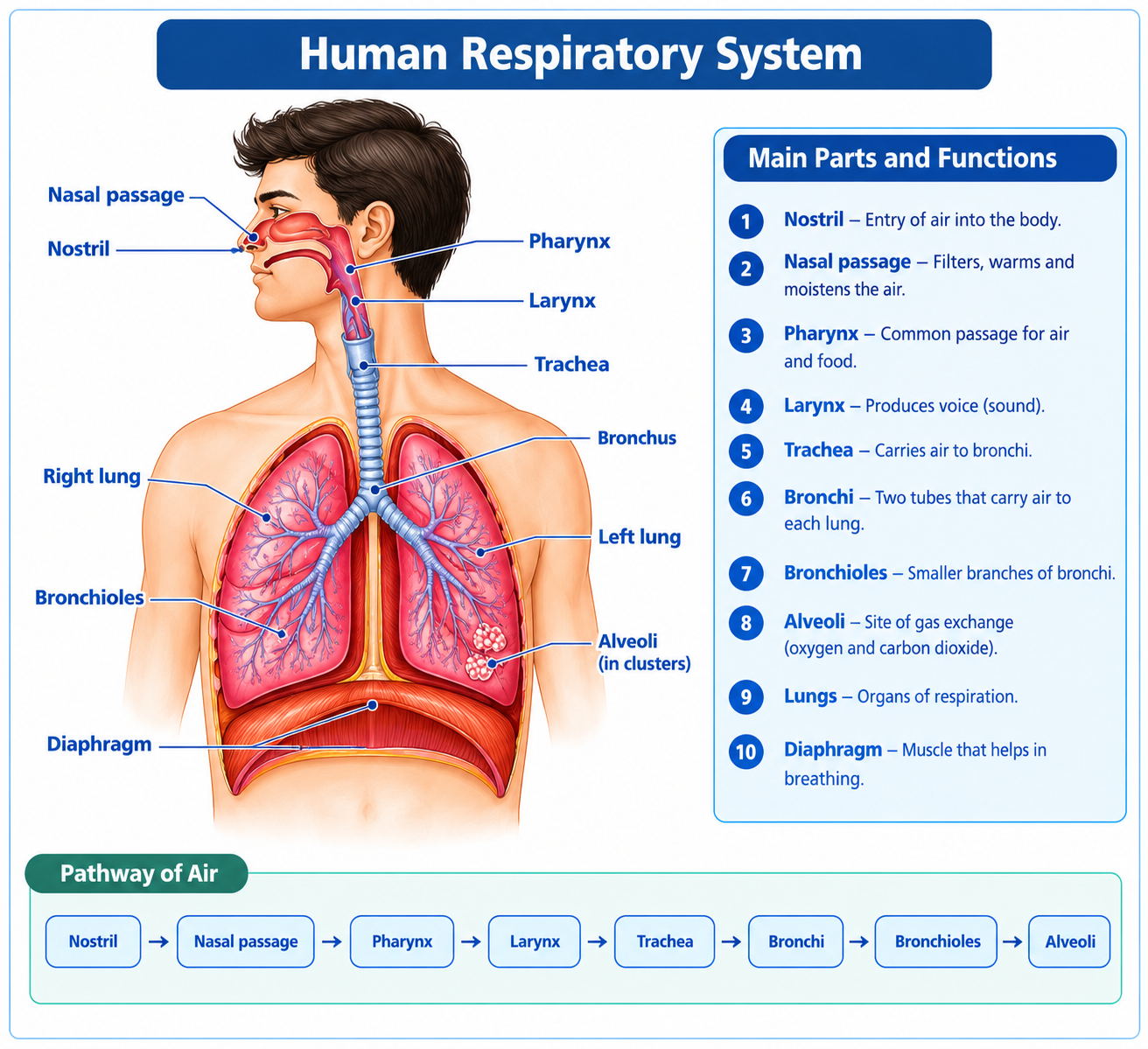
In humans, oxygen must enter the body and reach every cell, and carbon dioxide must leave. The respiratory system handles the gas exchange, while the blood handles the transport.
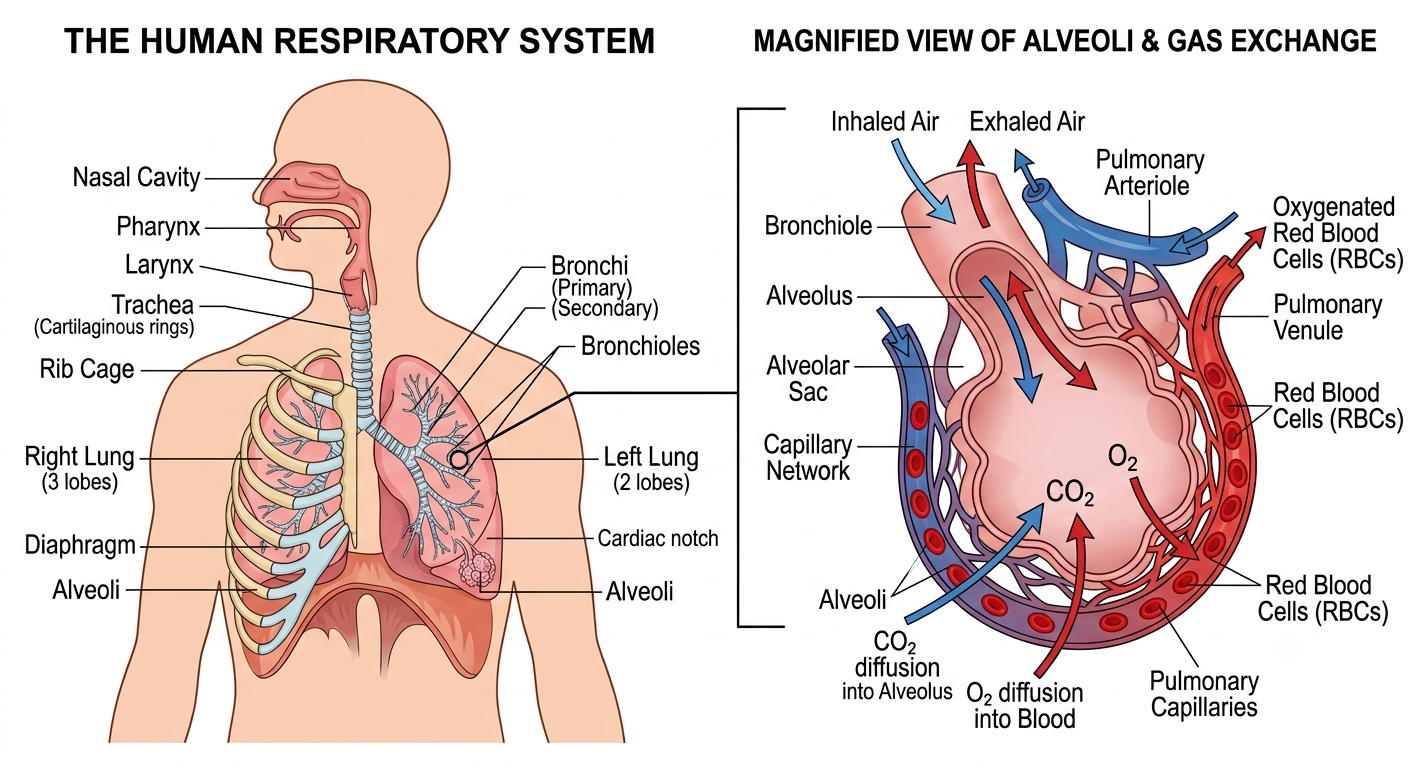
Nostrils and nasal passage
Air enters through the nostrils. The nasal passage is lined with hair and mucus. They trap dust particles and germs, and the rich blood supply warms the air before it goes further.
Pharynx and larynx
The pharynx is a common passage for food and air. The larynx (voice box) contains the vocal cords and produces sound. The opening of the larynx, the glottis, is covered by the epiglottis while swallowing so that food does not enter the windpipe.
Trachea, bronchi and bronchioles
The trachea (windpipe) is a tube supported by cartilage rings that keep it open. It divides into two bronchi — one entering each lung. Inside the lungs, each bronchus divides further into finer bronchioles, which finally end in small air sacs.
Alveoli and lungs
The bronchioles end in clusters of tiny balloon-like sacs called alveoli.
Alveoli are tiny, thin-walled air sacs at the end of bronchioles. Their walls are a single cell thick and richly supplied with blood capillaries, which makes them the actual site of gas exchange between the air and the blood.
The two lungs contain millions of alveoli, giving a huge surface area for gas exchange.
Mechanism of breathing
Breathing is done by the movement of the diaphragm (a muscular sheet below the lungs) and the ribs/intercostal muscles.
Transport of oxygen and carbon dioxide
- O₂ is carried mainly by haemoglobin inside red blood cells (as oxyhaemoglobin). A very small amount dissolves in plasma.
- CO₂ is carried in plasma (as bicarbonate), in red cells, and only a little dissolved in plasma as a gas.
When you run, your muscles need more oxygen and make more CO₂. Your breathing rate and heart rate rise so that more O₂ reaches the muscles faster and more CO₂ is thrown out. Your body adjusts breathing automatically to the demand.
7. Transportation in Human Beings
Food absorbed from the intestine and oxygen from the lungs must reach every cell, and wastes from cells must be removed. The blood and the heart do this for us.
Transportation is the movement of needed substances (oxygen, digested food, hormones, water) and wastes around the body through a transport system — in humans, the circulatory system.
Blood – the transport fluid
Blood is a red fluid tissue and has two parts: a liquid part (plasma) and cell-like parts (RBCs, WBCs, platelets).
- Plasma – the pale-yellow liquid that carries cells, hormones, digested food (glucose, amino acids) and waste (urea), and transports heat.
- Red blood cells (RBCs) – contain the red pigment haemoglobin which binds with oxygen and carries O₂ from lungs to all cells.
- White blood cells (WBCs) – the body’s defenders. They fight infection by engulfing germs (phagocytosis) and producing antibodies.
- Platelets – tiny fragments that help in clotting of blood at wounds.
Blood vessels
| Feature | Arteries | Veins |
|---|---|---|
| Blood pressure | High (carry blood away from heart) | Low (carry blood back to heart) |
| Wall | Thick, elastic, muscles | Thin walls |
| Valves | No valves | Valves present (prevent backflow) |
| Blood type carried | Usually oxygenated | Usually deoxygenated |
| Direction | Away from heart | Towards the heart |
| Exceptions | Pulmonary artery (deoxygenated) | Pulmonary vein (oxygenated) |
Capillaries are the finest blood vessels, with walls only one cell thick. Materials (O₂, food, CO₂, waste) are exchanged between blood and cells here. Capillaries join arteries to veins.
Why arteries have thick walls
Arteries carry blood away from the heart at high pressure, pushed by the beating of the heart. Thick, elastic, muscular walls withstand that pressure and help push the blood along by their elastic recoil.
Pulse
The rhythmic push of blood through arteries, felt every time the heart beats, is the pulse. It is felt where an artery runs close to the skin (e.g. wrist, neck).
Blood pressure
The force that blood exerts on the walls of the arteries is the blood pressure. It is highest during the contraction of the heart (systolic) and lowest during relaxation (diastolic), and is written as systolic/diastolic, for example 120/80 mm Hg. High pressure signals hypertension.
8. The Human Heart and Double Circulation
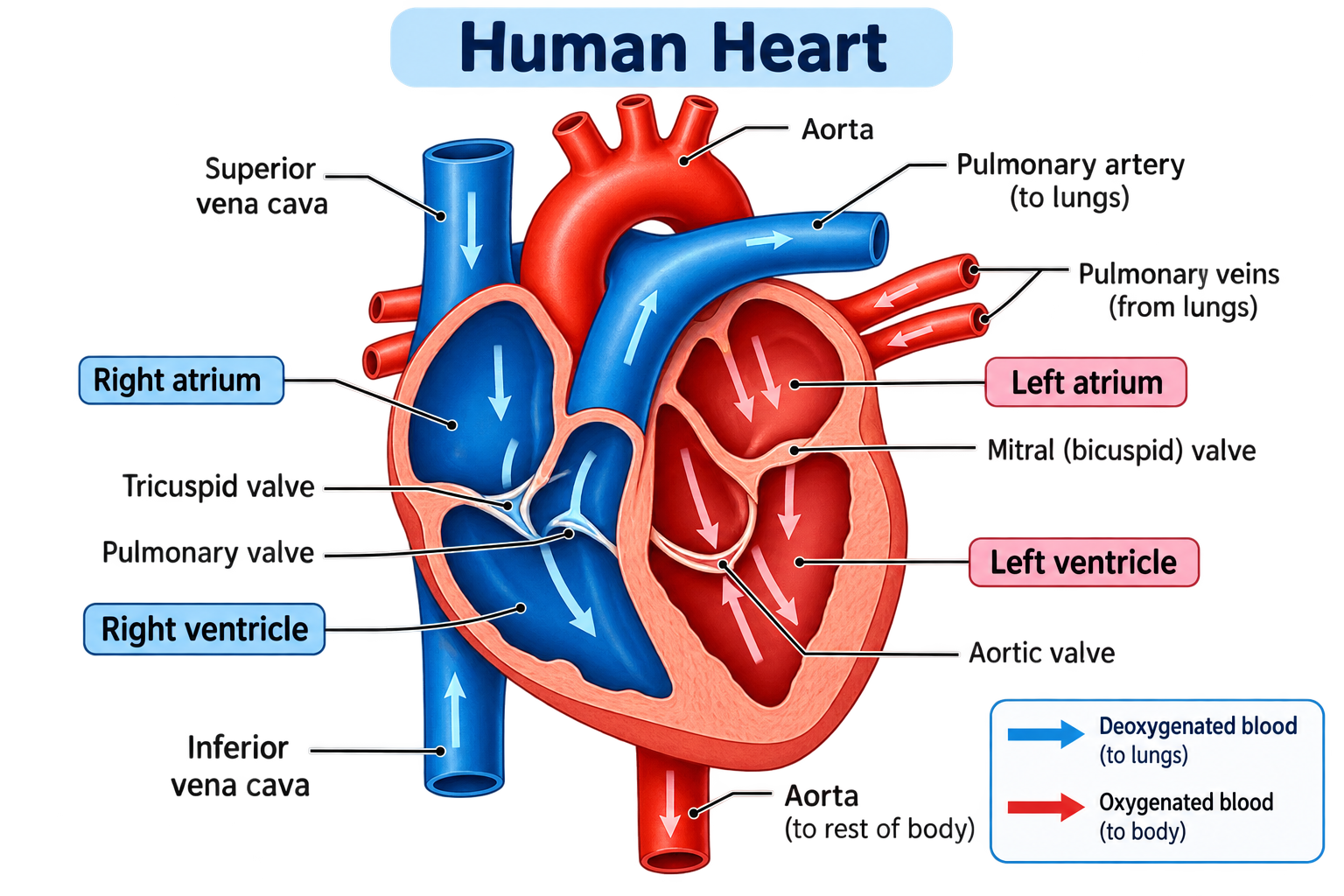
The heart is a muscular organ that pumps blood continuously to the whole body. It has four chambers and works as a double pump.
Two thin-walled atria (right and left) receive blood, and two thick-walled ventricles (right and left) pump blood out. The left ventricle has the thickest wall because it pumps blood to the whole body.
Pathway of blood through the heart
Body → Vena Cava → Right Atrium → Right Ventricle → Pulmonary Artery → Lungs → Pulmonary Vein → Left Atrium → Left Ventricle → Aorta → Body
Double circulation
Blood passes through the heart twice for one complete round of the body:
- Pulmonary circulation – right ventricle → lungs → left atrium (blood goes to lungs to pick up O₂).
- Systemic circulation – left ventricle → all body parts → right atrium (blood supplies the whole body and returns).
Double circulation is the double passage of blood through the heart for every complete circuit of the body — once through the lungs (pulmonary) and once through the body (systemic).
Why separation of oxygenated and deoxygenated blood matters
A four-chambered heart keeps the two types of blood completely separate. This allows:
- high-pressure, oxygen-rich blood to be delivered to the body efficiently;
- maximum uptake of oxygen in the lungs;
- efficient supply of energy for warm-blooded animals that need more fuel (like birds and mammals).
Valves in the heart and veins allow blood to flow in only one direction and stop it flowing backwards when the heart relaxes.
9. Transportation in Plants
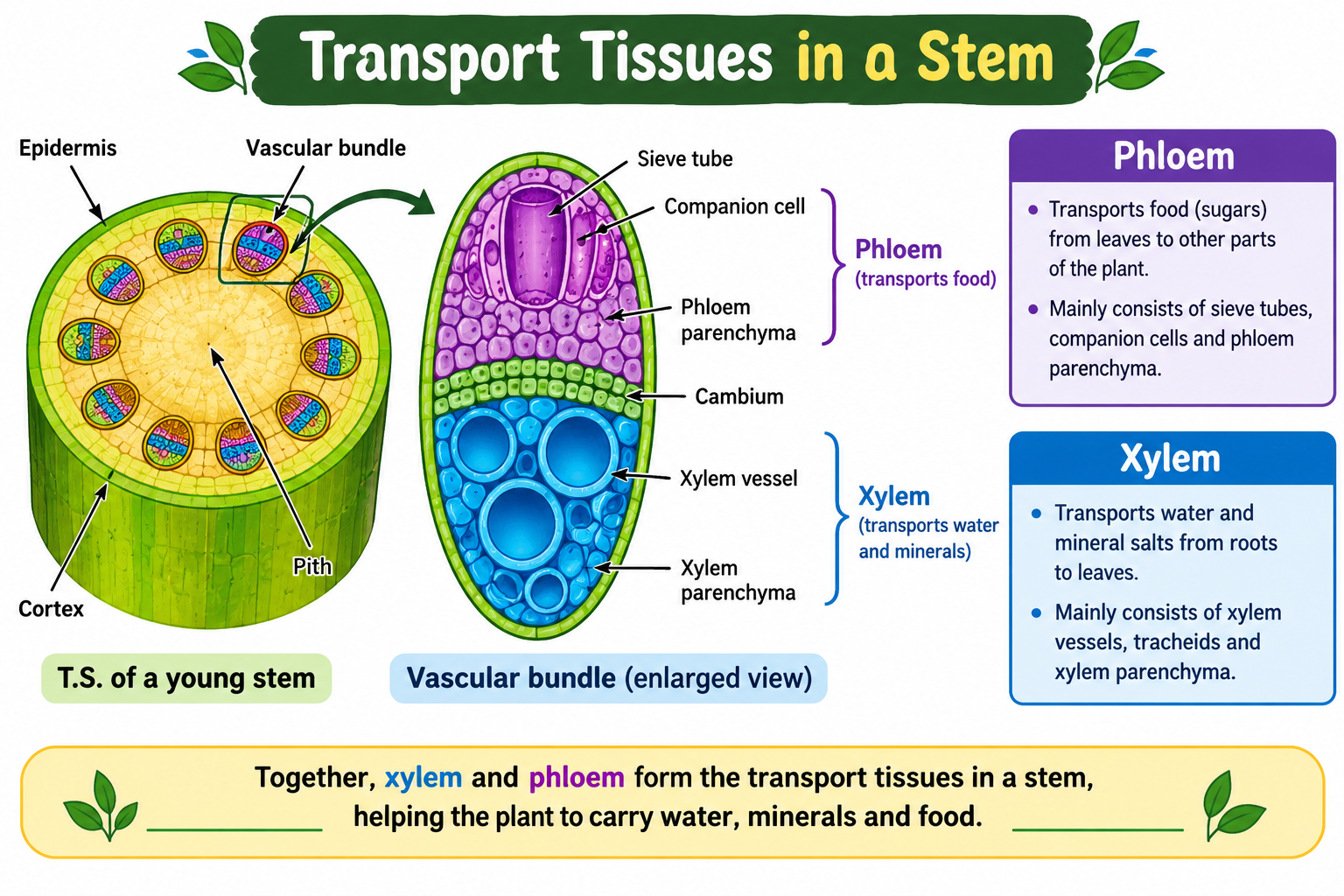
Plants have no heart or blood. Yet water, minerals, and food still need to move over long distances — water up from the roots to the leaves, and food from the leaves to every other part. This is done by two types of conducting tissues.
Xylem is the plant tissue that transports water and dissolved minerals from the roots upwards to all parts of the plant.
Phloem is the plant tissue that transports prepared food (sugars/amino acids) from the leaves to all parts of the plant, in both directions as needed.
Why plants need a transport system
Roots absorb water and minerals from the soil while the leaves make sugar using sunlight. Neither is wherever it is needed, so substances must be carried long distances. Multicellular plants that take up and use materials fast need transport tissues.
Transport of water and minerals
- Root hairs – fine outgrowths on the root that massively increase the surface area for absorbing water and minerals from the soil.
- Water moves into root hairs by osmosis (from low to high water concentration), then into the xylem.
- Xylem tubes run through the root, stem and into leaves, carrying water and minerals upward.
Transpiration is the loss of water vapour from the leaves (and other aerial parts) of a plant, mainly through the stomata.
As water evaporates from the leaves, more water is pulled up from the roots through the xylem — a force called transpiration pull. It helps draw water to the top of even very tall trees and also helps the plant cool down.
Why transpiration is important
- Creates the pull that carries water and minerals to the top of the plant.
- Helps keep the plant cool in bright sunlight.
- Exchanges gases for photosynthesis through open stomata.
- Helps in absorption and transport of water by maintaining continuous water column in xylem.
Transport of food – translocation
Translocation is the transport of prepared food (sugars, amino acids) from the leaves through the phloem to all parts of the plant — to growing tips, storage organs, fruits and roots.
Unlike xylem transport, phloem transport is multidirectional — the food can move up, down, sideways, wherever it is needed. Phloem uses some metabolic energy for this transport.
| Feature | Xylem | Phloem |
|---|---|---|
| Transports | Water and minerals | Food (sugars, amino acids) |
| Direction | Only upwards | Both directions as needed |
| Made of | Tracheids and vessels (dead cells) | Sieve tubes and companion cells (living cells) |
| Energy needed | No metabolic energy for flow | Uses metabolic energy |
| Location | Inner side of vascular bundle | Outer side of vascular bundle |
Transpiration is the loss of water vapour (gone from the plant). Translocation is the transport of food inside the plant (stays within). They are easily confused in exams — remember: transpiration moves water out, translocation moves food around.
Role of stomata
Stomata are tiny pores, each bordered by two guard cells. They perform three functions: gaseous exchange (CO₂ in, O₂ out), transpiration (loss of water vapour), and helping create the transpiration pull. The guard cells open and close the pore by changing their water content (osmosis).
10. Excretion
When cells break down food, metabolic processes produce waste. Some wastes are harmful and must be removed.
Excretion is the removal of harmful metabolic wastes produced inside an organism’s body, by special organs.
Why excretion is needed
Wastes like carbon dioxide, urea and excess salts are produced by normal metabolism. If they are left to collect, they poison the cells, change internal conditions, and can kill the organism. Excretion keeps the internal environment balanced and clean.
Main excretory products
- Carbon dioxide, water – from respiration.
- Urea – from the breakdown of excess proteins/amino acids in the liver.
- Excess salts and water – removed by the kidneys and skin (sweat).
Excretion removes wastes produced inside the body by metabolism (CO₂, urea). Egestion removes undigested food residue that never entered the body (faeces). Only excretion is covered by the word 'excretion' in this chapter.
11. Human Excretory System
In humans the main excretory organs are kidneys, which form urine to carry out nitrogenous waste (urea) and excess water and salts.
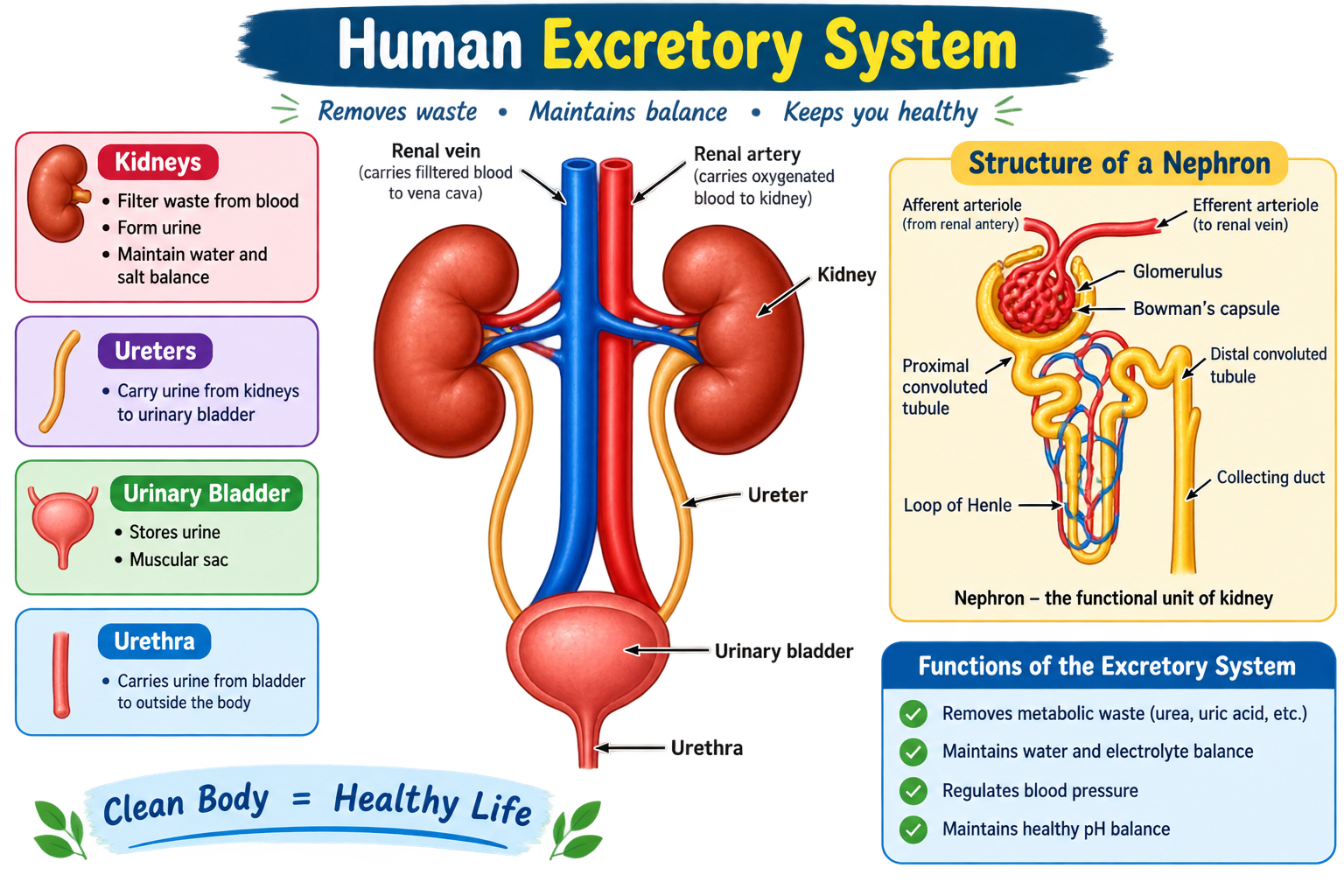
The human excretory system consists of a pair of kidneys, two ureters, the urinary bladder, and the urethra. Kidneys filter the blood, and urine is formed, stored and finally removed.
Kidney → Ureter → Urinary Bladder → Urethra
Nephron – the functional unit of the kidney
A nephron is the structural and functional unit of the kidney. Each kidney has about a million nephrons that filter blood and form urine. Each nephron has a Bowman’s capsule, a glomerulus, and a long renal tubule surrounded by blood capillaries.
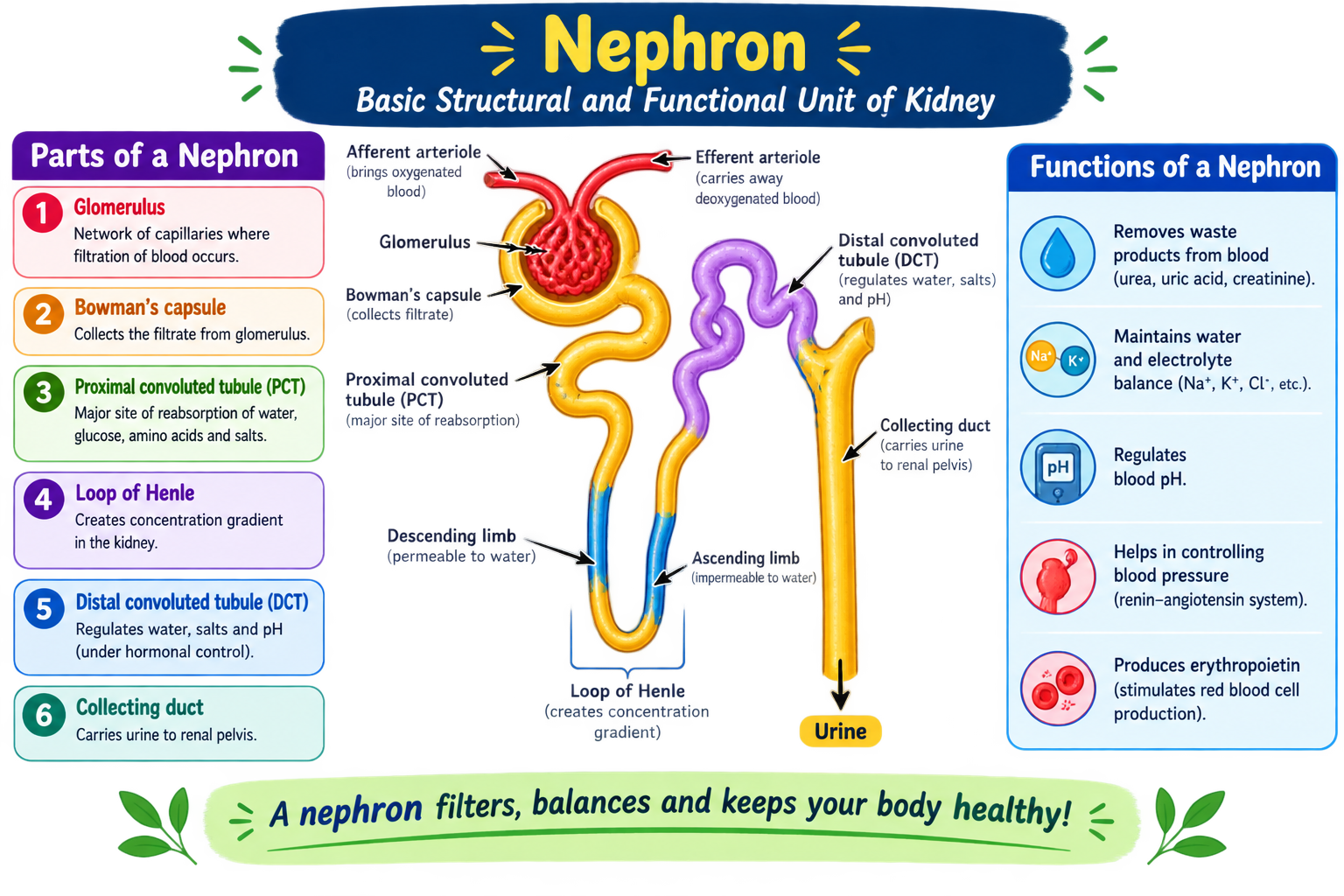
Parts of the nephron
- Glomerulus – a knot of blood capillaries inside the Bowman’s capsule where filtration begins.
- Bowman’s capsule – a cup-shaped sac holding the glomerulus; it collects the ultrafiltrate.
- Renal tubule – the long tube where selective reabsorption and tubular secretion occur.
- Blood capillaries – surround the tubule to exchange materials with the filtrate.
Urine formation – three steps
Ultrafiltration is the pressure-driven filtering of blood in the glomerulus, separating the filtrate from blood cells and proteins. Selective reabsorption is the reuptake, in the renal tubule, of only the useful substances (glucose, amino acids, needed water and salts) back into the blood.
Removal of urine
Urine from each nephron flows into collecting ducts, then to the ureters, and is stored in the urinary bladder. It is expelled through the urethra from time to time.
Other excretory organs
- Lungs – remove CO₂ and some water.
- Skin (sweat glands) – remove water, salts and traces of urea through sweat.
- Liver – converts excess amino acids to urea, which the kidneys then excrete.
12. Excretion in Plants
Plants do not have special excretory organs. They remove wastes more quietly, and they even store some wastes in harmless forms.
- Gaseous wastes – CO₂ (a respiration product) during the night and O₂ (a photosynthesis product) during the day are released through stomata.
- Liquid wastes / excess water – removed by transpiration (as water vapour through stomata).
- Storage in leaves and bark – many wastes are stored in old leaves or in bark.
- Excretion through falling leaves – leaves that accumulate waste materials are simply shed by the plant, taking the waste away.
- Resins and gums – plants like pine and acacia store some wastes as resins and gums (e.g. in bark), which harden and are discarded.
| Feature | Excretion in animals | Excretion in plants |
|---|---|---|
| Organs | Specialised organs (kidneys, lungs, skin) | No specialised organs |
| Main waste | CO₂, urea, excess water/salts | CO₂, O₂, excess water |
| Rate | Fast and continuous | Slow; wastes often stored |
| Removal method | Urine, breathing, sweat | Stomata, transpiration, fallen leaves, resins |
| Can store wastes? | Generally no | Yes – in leaves, bark, gums |
Trees like maple load waste materials into their leaves. In autumn the leaves change colour, die and fall, taking the stored wastes with them. The tree gets a fresh start — excretion by shedding!
13. Important Equations – Learn by Heart
| Process | Equation |
|---|---|
| Photosynthesis | \[ 6CO_2 + 6H_2O \xrightarrow[\text{chlorophyll}]{\text{sunlight}} C_6H_{12}O_6 + 6O_2 \] |
| Aerobic respiration | \[ C_6H_{12}O_6 + 6O_2 \to 6CO_2 + 6H_2O + \text{Energy} \] |
| Anaerobic (yeast) | \[ C_6H_{12}O_6 \to 2C_2H_5OH + 2CO_2 + \text{Energy} \] |
| Anaerobic (muscles) | \[ C_6H_{12}O_6 \to 2\, C_3H_6O_3 + \text{Energy} \] |
For board answers, always include the condition over the arrow (sunlight + chlorophyll for photosynthesis) — marks are awarded for the complete equation.
14. Important Definitions
Basic functions that an organism performs continuously to stay alive — nutrition, respiration, transportation, and excretion.
The process of taking in food, breaking it down into simpler substances and using it for energy, growth and repair.
The process by which green plants make glucose from carbon dioxide and water in the presence of sunlight and chlorophyll, releasing oxygen.
Nutrition in which an organism makes its own food from simple inorganic substances using light energy (e.g. green plants).
Nutrition in which an organism takes in complex organic food prepared by other organisms (e.g. animals, fungi).
The process by which organisms release energy from glucose (food) inside their cells, usually with oxygen, storing it as ATP.
Breakdown of glucose with oxygen to release maximum energy as CO₂, H₂O and ATP.
Breakdown of glucose without oxygen, releasing less energy and forming ethanol + CO₂ (yeast) or lactic acid (muscles).
The wave of muscle contraction and relaxation that pushes food along the alimentary canal.
Tiny thin-walled air sacs in the lungs, surrounded by blood capillaries, where gaseous exchange takes place.
The movement of needed substances and wastes around a body through a transport system (blood in humans, xylem/phloem in plants).
The double passage of blood through the heart per full circuit of the body — once through the lungs (pulmonary) and once through the body (systemic).
The loss of water vapour from the aerial parts of a plant, mainly through stomata.
The transport of prepared food from leaves (through phloem) to all parts of the plant.
The removal of harmful metabolic wastes produced inside the body, by special organs.
The structural and functional unit of the kidney that filters blood and forms urine; it has a glomerulus, Bowman’s capsule and a renal tubule.
The pressure-driven filtration of blood in the glomerulus that lets water, glucose, salts, amino acids and urea into the Bowman’s capsule.
The reuptake of only the useful substances (glucose, amino acids, needed water and salts) from the filtrate back into the blood in the renal tubule.
15. Solved Examples
A. Basic concept questions
Q1. What are life processes? Name the four major life processes.
Concept: Life processes are the basic functions that keep an organism alive.
Solution: Life processes are the basic functions that an organism performs continuously to stay alive. The four major life processes are (1) Nutrition, (2) Respiration, (3) Transportation and (4) Excretion.
Final answer: Nutrition, Respiration, Transportation, Excretion.
Q2. Define nutrition. What is the difference between autotrophic and heterotrophic nutrition?
Concept: Nutrition is how organisms obtain and use food.
Solution: Nutrition is the process of taking in food and using it for energy, growth and repair. In autotrophic nutrition organisms make their own food from inorganic substances using sunlight (e.g. green plants); in heterotrophic nutrition organisms depend on other organisms for their food (e.g. animals, fungi).
Final answer: Autotrophic = self-made food; heterotrophic = food from others.
Q3. Write the balanced equation for photosynthesis.
Concept: Photosynthesis uses CO₂ + H₂O to make glucose and oxygen.
Solution: \[ 6CO_2 + 6H_2O \xrightarrow[\text{chlorophyll}]{\text{sunlight}} C_6H_{12}O_6 + 6O_2 \]
Final answer: Six molecules of CO₂ combine with six of water to give one glucose and six oxygen molecules, using sunlight and chlorophyll.
Q4. Name the organs of the human respiratory system in order from nostrils to alveoli.
Concept: Recall the pathway of air.
Solution: Nostrils → nasal passage → pharynx → larynx → trachea → bronchi → bronchioles → alveoli.
Final answer: Nostrils, nasal passage, pharynx, larynx, trachea, bronchi, bronchioles, alveoli.
Q5. What is the functional unit of the kidney? Name its parts.
Concept: The nephron is the unit that filters blood and forms urine.
Solution: The nephron is the structural and functional unit of the kidney. Its parts are the glomerulus, Bowman’s capsule, and the renal tubule, surrounded by blood capillaries.
Final answer: Nephron – glomerulus, Bowman’s capsule and renal tubule.
B. Moderate questions
Q6. Distinguish between breathing and respiration.
Concept: One is gas exchange, the other is energy release.
Solution: Breathing is the physical intake of oxygen and giving out of carbon dioxide (gas exchange in lungs). Respiration is the chemical breakdown of glucose inside cells to release energy. Breathing supplies oxygen for respiration; respiration is the actual energy-release step. Breathing needs no enzymes and gives no energy; respiration needs enzymes and produces ATP.
Final answer: Breathing = gas exchange; respiration = energy release from glucose in cells.
Q7. Why are alveoli and villi good at their jobs? Give two reasons each.
Concept: Both use a large surface area and thin walls with rich blood supply.
Solution: Alveoli: (i) large surface area for gas exchange, (ii) single-cell-thick walls and abundant capillaries for quick diffusion. Villi: (i) large surface area for absorption of digested food, (ii) thin walls with blood capillaries (and lacteal) so nutrients enter blood easily.
Final answer: Large surface area + thin walls + rich blood supply make both highly efficient.
Q8. With the help of a flow chart, show the fate of glucose after it is broken into pyruvate.
Concept: Glucose → pyruvate (cytoplasm), then three possible paths.
Solution: Glucose breaks into pyruvate in the cytoplasm. Pyruvate then: (i) in presence of O₂ → CO₂ + H₂O + energy (mitochondria, aerobic); (ii) in absence of O₂ in yeast → ethanol + CO₂ + energy; (iii) in absence of O₂ in muscles → lactic acid + energy.
Final answer: Pyruvate to ethanol+CO₂ (yeast), or lactic acid (muscles), or fully to CO₂+H₂O (aerobic, mitochondria).
Q9. Trace the path of a red blood cell travelling from the right atrium back to the right atrium.
Concept: Follow the heart pathway and both circulations.
Solution: Right atrium → right ventricle → pulmonary artery → lungs → pulmonary vein → left atrium → left ventricle → aorta → body → vena cava → right atrium.
Final answer: RA → RV → pulmonary artery → lungs → pulmonary vein → LA → LV → aorta → body → vena cava → RA.
Q10. What is the role of hydrochloric acid and pepsin in the stomach?
Concept: HCl makes the medium acidic and pepsin digests protein in that medium.
Solution: Hydrochloric acid (HCl) creates an acidic medium in the stomach and kills microbes that enter with food. Pepsin is a protein-digesting enzyme that works best in an acidic medium, breaking proteins into peptides. Mucus protects the stomach wall from HCl.
Final answer: HCl = acidic medium + germ killing; pepsin = protein digestion in that acidic medium.
Q11. How is oxygen transported in the body? How is carbon dioxide transported?
Concept: Different carriers for the two gases.
Solution: Oxygen is carried mainly by haemoglobin in red blood cells as oxyhaemoglobin (a little dissolves in plasma). Carbon dioxide is mostly carried in plasma (as bicarbonate), some in RBCs, and a little dissolved as gas.
Final answer: O₂ by haemoglobin; CO₂ mainly in plasma as bicarbonate.
Q12. Differentiate between transpiration and translocation in plants.
Concept: Water loss vs food transport.
Solution: Transpiration is the loss of water vapour from leaves through stomata; it creates a pull that draws up water and helps cool the plant. Translocation is the transport of prepared food from leaves to all other parts through phloem. Transpiration loses water to the air; translocation moves food within the plant.
Final answer: Transpiration = outward loss of water; translocation = inward movement of food via phloem.
C. Application-based questions
Q13. After a heavy meal, why do you feel the need to breathe more while climbing stairs?
Concept: Muscles need more energy and so more oxygen.
Solution: Climbing stairs makes the leg muscles work hard. They need more energy quickly, so their rate of respiration rises. More respiration needs more oxygen and produces more CO₂. To meet this, the breathing rate increases so more O₂ reaches muscles and the extra CO₂ is removed.
Final answer: Higher muscle activity → higher oxygen demand → faster, deeper breathing.
Q14. Why does a doctor in a hypertension report write blood pressure as 150/95 mm Hg? What do the two numbers mean?
Concept: Systolic and diastolic pressure.
Solution: The first number (150) is the systolic pressure — the pressure in the arteries when the heart contracts. The second (95) is the diastolic pressure — the pressure when the heart relaxes. A reading above the normal ~120/80 suggests high blood pressure (hypertension).
Final answer: Systolic (contraction) / diastolic (relaxation) in mm Hg.
Q15. A farmer waters his field during a bright sunny afternoon. A day later the leaves still look wilted. Suggest one possible reason and the correction a student of biology would offer.
Concept: Transpiration rate and water supply.
Solution: On a hot sunny day transpiration is very rapid. Even after watering, if the water was given when the stomata and xylem were already stressed, leaves may remain wilted until transpiration rate falls. It is better to water in the early morning or evening so the plant has time to take up and hold water before the hottest part of the day.
Final answer: Wilt = water lost by transpiration faster than roots can supply; water early morning/evening to avoid it.
Q16. Why is the wall of the left ventricle thicker than the right ventricle?
Concept: The left ventricle pumps blood to the whole body.
Solution: The left ventricle pumps oxygenated blood through the aorta to the entire body, so it must generate high pressure and force. The right ventricle only pumps blood to the nearby lungs. The thicker muscular wall of the left ventricle supplies the extra force needed for systemic circulation.
Final answer: More pumping force is needed for the whole body than for the lungs only.
Q17. Why is it essential to have a large number of alveoli in the lungs rather than one large bag?
Concept: Surface area and transport efficiency.
Solution: Thousands of tiny alveoli provide a huge total surface area compared to one large sac of the same volume. A large surface area, combined with thin moist walls and rich blood capillaries, allows rapid and efficient exchange of O₂ and CO₂ between air and blood at a rate that meets the body’s full oxygen demand.
Final answer: Large surface area → fast, efficient gas exchange.
D. Competency / reasoning questions
Q18. A plant is kept in a dark room for 48 hours and then a variegated leaf is tested with iodine. Only the green part of the leaf turns blue-black. Explain.
Concept: Chlorophyll traps light; starch forms only where chlorophyll + light act.
Solution: The dark treatment removes all stored starch. In the light, only areas that contain chlorophyll can carry out photosynthesis and make starch. The iodine test turns blue-black where starch is present — so only the green regions show the colour. This experiment proves that chlorophyll is needed for photosynthesis.
Final answer: Blue-black = starch; starch forms only in chlorophyll-containing part → chlorophyll is essential.
Q19. Why do we breathe faster when we run, and slower when we sit quietly?
Concept: Breathing rate matches oxygen demand.
Solution: Running muscles need more O₂ for aerobic respiration and produce more CO₂. The brain senses the rising CO₂ level, so the breathing rate and depth increase to take in more O₂ and remove more CO₂. At rest the demand is low, so breathing slows down.
Final answer: Breathing adjusts to the body’s changing need for O₂ / removal of CO₂.
Q20. A person’s diet has too much protein. Which waste increases in the blood and which organ must work overtime?
Concept: Amino acids are deaminated to urea in the liver, excreted by the kidney.
Solution: Excess amino acids are broken down in the liver and the nitrogen is converted to urea. Urea concentration in blood rises, so the kidneys (nephrons) must filter more urea into urine. Over a long time an excess-protein diet makes the kidneys work harder.
Final answer: Urea increases; the kidneys work harder to excrete it.
Q21. Why do stomata usually open by day and close at night in most plants?
Concept: Stomata serve photosynthesis (needs light) and regulate water loss.
Solution: In daytime, light enables photosynthesis, which needs CO₂ to enter through the stomata; guard cells open the pores. At night photosynthesis stops (no light), but transpiration would still lose water, so stomata close to conserve water. The pattern balances gas uptake with water loss.
Final answer: Open by day for CO₂ uptake during photosynthesis; closed at night to reduce water loss.
E. Case-based questions
Case 1 (Photosynthesis). A student set up two potted plants.
Case: Plant A is kept in sunlight, Plant B in a dark cupboard. Both are watered regularly. After one week, iodine solution is used on leaves of both plants.
Q(i): Which leaf will turn blue-black and why? A(i): Plant A. It had light, so it could photosynthesise and store starch; iodine turns blue-black in starch. Plant B made no starch in the dark.
Q(ii): What word lists the conditions needed for photosynthesis from this comparison? A(ii): It shows sunlight (light energy) is needed for photosynthesis.
Q(iii): If Plant B is returned to sunlight for two days before testing, what result is expected? A(iii): Its leaves would now turn blue-black because the light restored photosynthesis and starch formation.
Case 2 (Digestion). Riya ate a meal of rice (starch), dal (protein) and a fried snack (fat).
Case: The meal travels through the alimentary canal and is digested step by step.
Q(i): Where does the digestion of the rice (starch) begin? A(i): In the mouth, where salivary amylase breaks starch into maltose.
Q(ii): In which organ does the dal (protein) get digested and with which enzyme? A(ii): Protein digestion begins in the stomach with pepsin in the acidic medium (HCl), and continues in the small intestine with pancreatic trypsin.
Q(iii): Which juice breaks the fat into tiny droplets, and where is it produced? A(iii): Bile, produced by the liver (stored in the gall bladder), emulsifies fats in the small intestine.
Case 3 (Respiration). A long-distance runner finishes a 400 m sprint and feels a burning pain in the calf muscles.
Case: The sprint used more oxygen than could be supplied.
Q(i): What changes occur in the muscle cells during the sprint that cause the pain? A(i): Oxygen supply falls short, so muscles respire anaerobically and produce lactic acid, whose accumulation causes burning cramps.
Q(ii): What happens to the lactic acid after a short rest? A(ii): With fresh oxygen supplied, the lactic acid is slowly broken down (oxidised) or converted, and the cramps ease.
Q(iii): Name the energy molecule produced in both aerobic and anaerobic respiration. A(iii): ATP (adenosine triphosphate).
Case 4 (Circulation). In a biology practical, a student listens with a stethoscope on the chest of a friend at rest and then after running.
Case: The student notices the heartbeat rate changes.
Q(i): Why does the heart beat faster after running? A(i): Working muscles need more oxygen and produce more CO₂, so the heart pumps faster to deliver oxygenated blood and remove wastes quickly.
Q(ii): Which chambers receive blood, and which pump it out? A(ii): The atria receive blood (right from vena cava, left from pulmonary vein) and the ventricles pump it out (right to lungs, left to body via aorta).
Q(iii): Why is it important that oxygenated and deoxygenated blood are kept separate? A(iii): It allows efficient, high-pressure delivery of oxygen-rich blood to the body and maximum oxygen pickup, essential for high-energy animals.
16. Application-Based Learning
These questions test whether you can use Chapter 5 ideas in everyday situations. Try to answer before reading the reveal.
App 1. Why do we sip a cold drink through a straw, while a plant pulls water through its stem?
Answer: We create lower pressure in the straw by the muscles of our mouth; a plant relies on transpiration pull — water evaporating from leaves creates a vacuum-like pull that draws the water column up the xylem.
App 2. Street food vendors wrap idli/chutney in a banana leaf. Why do leafy wrappers keep food moist?
Answer: The banana leaf is thick, waxy and has few stomata, so it loses little water by transpiration. Its low water loss keeps the food from drying out.
App 3. Why should athletes not sprint immediately after a heavy meal?
Answer: After a meal, blood flow is diverted to the digestive organs for digestion. Sprinting needs blood in the muscles, so the two compete — digestion slows, and muscles get less oxygen → early cramps and discomfort.
App 4. A person with kidney failure is advised dialysis. What does the dialysis machine substitute for the kidney?
Answer: It acts as an artificial kidney. Blood flows through tubes in a dialysis fluid, and wastes like urea diffuse out of the blood into the fluid — cleaning the blood in place of nephron filtration.
App 5. In high mountains breathing becomes difficult. Why?
Answer: At high altitude the air has less oxygen. The partial pressure of O₂ is low, so less oxygen binds to haemoglobin. The body compensates by breathing faster and making more RBCs, but the lift of oxygen per breath is still less.
App 6. A gardener notices the leaves of a Banyan tree drooping at noon. Explain using transpiration.
Answer: At noon, bright sunlight and warmth speed up transpiration faster than roots can supply water. The temporary water-shortage inside leaves makes them droop (temporary wilting). By evening, when transpiration falls, they become turgid again.
App 7. Why is blood described as a 'tissue' though it is a liquid?
Answer: Blood is a connective tissue because it has cells (RBCs, WBCs, platelets) suspended in a liquid matrix (plasma), and it connects and carries materials between different parts of the body.
App 8. While lifting heavy weights, many athletes unconsciously hold their breath. Which gas builds up that urges them to breathe?
Answer: Carbon dioxide. The brain’s respiratory centre is most sensitive to rising CO₂ levels (not falling oxygen), which stimulates the urge to breathe again.
17. Competency-Based Questions
These go beyond recall — they ask you to apply, analyse and connect ideas.
Comp 1. Amit measured his pulse at rest (72 beats/min) and after running (124 beats/min).
Q: Give two changes that happened in his body that explain the rise.
Answer: (i) Working muscles consumed more O₂ and produced more CO₂; (ii) the heart pumped faster and stronger so O₂-rich blood reached muscles faster and CO₂ was removed quickly.
Comp 2. A leaf was removed from a plant and its lower surface was coated with vaseline. The plant was then watered and kept in the sun.
Q: Predict what happens to that leaf and explain.
Answer: The lower surface holds most stomata. Vaseline blocks the stomata, so (i) gaseous exchange stops and (ii) transpiration from that leaf practically stops. The leaf gets little CO₂ and cannot cool itself; it will gradually yellow and may dry out, while other leaves keep working.
Comp 3. Two patients visit a clinic. Patient X’s urine contains glucose and a lot of water. Patient Y’s urine contains blood cells.
Q: Which part of the kidney is most likely affected in each? Justify.
Answer: X – glucose normally appears in the ultrafiltrate and is fully reabsorbed in the renal tubule; glucose in the urine suggests failure of selective reabsorption (or high blood sugar). Y – blood cells never leave the glomerulus during normal filtration, so a damaged glomerulus (allowing cells through) is indicated.
Comp 4. Suresh compared the heart rates of a frog and an adult human over two hours. He found the frog’s heart rate can slow a lot when cold.
Q: Explain why a cold-blooded animal’s heart rate changes with temperature, and why a human’s changes less.
Answer: Frogs are cold-blooded: their body temperature equals the surroundings. Metabolism (and hence heart rate) is slow in cold and fast in warmth. Humans are warm-blooded and maintain a constant ~37 °C core, so their resting metabolic rate (and heart rate) stays nearly stable.
Comp 5. A potted plant was placed under a glass jar for a day. Droplets appeared on the inside of the jar.
Q: Is this only transpiration, or could it include another process? Justify.
Answer: Mostly transpiration (water vapour lost through stomata condenses on the cold jar wall). It can include a little water lost from the soil surface by evaporation, but in an airtight jar the main source is transpiration from the leaves.
Comp 6. Ravi ran a 100 m race and developed a cramp. His coach said, "Your muscles switched to anaerobic mode."
Q: Write the equation for what happens in Ravi’s muscles and explain why the pain goes away after rest.
Answer: \[ C_6H_{12}O_6 \to 2\, C_3H_6O_3 + \text{Energy} \] Lactic acid accumulated in the muscles causes the burning sensation. On rest, fresh oxygen is supplied, the lactic acid is gradually removed/oxidised, and the cramp eases.
18. Case-Based Learning
Case Study 1 – The Wilted Potted Plant
Ramesh placed two identical potted plants in bright sunlight. He covered Plant A’s soil surface with a plastic sheet and left Plant B’s soil open. He watered both equally for a week.
Q1. Why did Ramesh cover the soil of Plant A? (1 mark)
Answer: To prevent direct evaporation of water from the soil, so that any water lost by Plant A is mainly lost by transpiration through the plant.
Q2. Both leaves from Plant A were tested with cobalt chloride paper. Which side turns pink first and why? (2 marks)
Answer: The lower surface turns pink first because it has the larger number of stomata and loses more water vapour (transpiration). The paper turns pink because moisture turns cobalt chloride blue paper pink.
Q3. If two leaves of Plant A, equal in area, are taken – one coated on the lower surface with vaseline and the other left natural – which leaf shows faster water loss? (1 mark)
Answer: The natural leaf, because its stomata are open for transpiration; vaseline blocks the stomata of the coated leaf.
Case Study 2 – The Dialysis Patient
Meena’s grandfather’s kidneys failed. The doctor prescribed dialysis twice a week. In dialysis, blood is passed through tubes immersed in a special fluid, and clean blood is returned to the body.
Q1. Which organ do the dialysis tubes and special fluid together imitate? (1 mark)
Answer: The kidneys (nephrons / glomerulus) and the urine-forming process – filtration of waste from blood.
Q2. Which waste accumulates in blood when kidneys fail, and name one complication if it is not removed. (2 marks)
Answer: Urea (and excess salts/water). If not removed, they poison the body and can lead to heart complications or kidney-related organ failure.
Q3. Why does the blood losing urea to the fluid not also lose the useful glucose? (2 marks)
Answer: The dialysis fluid is made with a glucose concentration similar to blood, so glucose does not diffuse out, while urea (which is in high concentration in blood and absent in the fluid) diffuses into the fluid down its concentration gradient.
Case Study 3 – The Heart Beat Monitor
A smart-watch shows a person’s heart rate rising from 72 to 124 beats/min during exercise and returning to 70 in rest.
Q1. Which muscle in the heart is responsible for pumping blood?
Answer: The myocardium (cardiac muscle) – the thick muscular wall of the heart, especially in the ventricles.
Q2. Give two reasons the heart rate rises during exercise.
Answer: (i) Muscles need more O₂ and glucose for ATP; (ii) more CO₂ must be flushed out, so blood needs to circulate faster.
Q3. The heart has four chambers. Which chamber’s walls are thickest and why?
Answer: Left ventricle. It has to pump oxygenated blood through the aorta to the entire body under high pressure.
Case Study 4 – The Variegated Leaf
A student destarched a variegated (part green, part white) plant leaf, then kept it in light for 6 hours. On testing with iodine, only the green parts turned blue-black.
Q1. Why must the plant be destarched (kept in dark) before the experiment?
Answer: To remove any previously stored starch so the test shows only starch newly made in the experiment.
Q2. Why did only the green regions turn blue-black?
Answer: Only the green parts contain chlorophyll, which is essential to trap light energy for photosynthesis. The white parts have no chlorophyll, so no starch and no colour change.
Q3. What conclusion about photosynthesis does this experiment support?
Answer: It proves that chlorophyll is necessary for photosynthesis (starch is made only where chlorophyll is present).
Q4. If the leaf is tested again after keeping it 12 hours in darkness, what would change?
Answer: The blue-black colour would be weaker or disappear because starch is used up in dark (no photosynthesis, stored starch consumed).
Case Study 5 – The Experimental Setup
A student set up a burette with a funnel and connected it to a beaker of lime water. He bubbled exhaled air through lime water; the lime water turned milky.
Q1. What does the milky lime water prove about exhaled air?
Answer: It proves exhaled air contains carbon dioxide (CO₂ turns lime water milky).
Q2. Where in the body does this CO₂ come from, and what is it a product of?
Answer: It comes from cells, where glucose is broken down during respiration (aerobic) to release energy, producing CO₂ and water.
Q3. Why was the air exhaled after we breathe in?
Answer: Because the diffused oxygen from the inhaled air is used up by the cells; the CO₂ produced in the cells is carried by blood and diffused into the alveoli before being exhaled.
Q4. Why is it important for the lime water experiment that the air is exhaled and not inhaled?
Answer: Inhaled air has less CO₂ than exhaled air; exhaled air is CO₂-rich, so the change is visible. This shows respiration releases CO₂.
19. Self-Practice Questions (with Answer Key)
Attempt all questions on paper before checking the key below. Mix of MCQs (`Ans`), very short answers (VSA), short answers (SA), and reasoning questions.
Multiple-Choice Questions
- The modes of nutrition in an organism that makes its own food using chlorophyll are called:
(a) heterotrophic (b) saprophytic (c) autotrophic (d) parasitic Ans: (c) - The site of aerobic respiration in a cell is the:
(a) nucleus (b) mitochondria (c) ribosome (d) Golgi bodies Ans: (b) - Which of these carries oxygenated blood in the human body?
(a) pulmonary artery (b) pulmonary vein (c) vena cava (d) right ventricle Ans: (b) - The movement of food along the alimentary canal is by:
(a) digestion (b) peristalsis (c) egestion (d) diffusion Ans: (b) - The functional unit of the kidney is the:
(a) alveolus (b) villus (c) nephron (d) tubule Ans: (c) - Blood plasma carries dissolved carbon dioxide mostly as:
(a) oxyhaemoglobin (b) sodium bicarbonate (c) urea (d) carbonic acid solution in cells Ans: (b) - The opening and closing of stomata is controlled by:
(a) xylem cells (b) guard cells (c) phloem sieve tubes (d) companion cells Ans: (b) - Which part of the human digestive system releases bile?
(a) gall bladder (b) stomach (c) small intestine (d) liver Ans: (d) liver produces bile; (a) stores it - In anaerobic respiration, yeast produces ethanol and carbon dioxide with release of:
(a) 38 ATP (b) 2 ATP (c) 0 ATP (d) 20 ATP Ans: (b) - The thickest wall in the heart is of the:
(a) right atrium (b) left ventricle (c) right ventricle (d) left atrium Ans: (b)
Very Short Answer (VSA)
- Name the gland that secretes saliva. Ans: Salivary glands (parotid/sublingual/submandibular).
- What is the pigment that traps sunlight in leaves? Ans: Chlorophyll.
- Where in a nephron does selective reabsorption occur? Ans: In the renal tubule.
- Name the gas released during photosynthesis. Ans: Oxygen.
- Which vessel carries deoxygenated blood to the lungs? Ans: Pulmonary artery.
- What is the functional unit of respiration in the lungs? Ans: Alveoli.
- Give one product excreted by plants through stomata. Ans: CO₂ (also O₂ or water vapour).
- Name the green pigment that opens and closes the stomatal pore. Ans: Guard cells (osmotic swelling).
- What is the medium required for pepsin to act on proteins? Ans: Acidic (HCl in stomach).
- Name the enzyme present in saliva. Ans: Salivary amylase (ptyalin).
Short Answer (SA)
- Write the balanced chemical equation of photosynthesis. Ans: 6CO₂ + 6H₂O →[sunlight/chlorophyll] C₆H₁₂O₆ + 6O₂.
- State three functions of stomata. Ans: Gaseous exchange, transpiration (water loss), and helping transpiration pull.
- Why do arteries have thick, elastic walls while veins do not? Ans: Arteries carry blood at high pressure from the heart; veins carry low-pressure blood towards the heart.
- What is double circulation? Why is it important in humans? Ans: Blood passes through the heart twice per circuit (pulmonary + systemic). It keeps oxygenated and deoxygenated blood separate, so tissues always get oxygen-rich blood.
- Compare aerobic and anaerobic respiration in a table (oxygen use, products, energy). Ans: Aerobic uses O₂ → CO₂+H₂O+max energy; anaerobic without O₂ → ethanol+CO₂ (yeast) or lactic acid (muscles), less energy.
- Differentiate between xylem and phloem (function, direction, energy). Ans: Xylem carries water/minerals one-way up, no metabolic energy; phloem carries food both ways, uses energy.
- Explain why transpiration is important for a plant. Ans: Creates transpiration pull, cools the plant, and indirectly aids absorption and transport of water/minerals.
- What are the three steps of urine formation in a nephron? Ans: Ultrafiltration in glomerulus; selective reabsorption in renal tubule; tubular secretion into the filtrate.
- Why is the left ventricle’s wall thicker than the right? Ans: Left ventricle pumps blood to the entire body (high pressure), right ventricle only to the lungs.
- How is carbon dioxide transported in human blood? Ans: Mostly in plasma as dissolved bicarbonate; some in RBCs; a little as dissolved gas.
Assertion-Reason (Competency)
- Assertion: In anaerobic respiration, muscles produce lactic acid.
Reason: When oxygen is insufficient, pyruvate is converted to lactic acid instead of CO₂ and water.
Ans: Both A and R are true, and R is the correct explanation of A. - Assertion: Blood is a connective tissue.
Reason: It connects different parts by carrying materials while having cells in a liquid matrix.
Ans: Both A and R are true, and R is the correct explanation of A. - Assertion: Nephron is the functional unit of the kidney.
Reason: All filtration and selective reabsorption happen in the nephron.
Ans: Both A and R are true, and R is the correct explanation of A. - Assertion: The pulmonary artery carries deoxygenated blood.
Reason: Arteries always carry oxygenated blood in the human body.
Ans: A is true but R is false (arteries carry blood away from the heart; the pulmonary artery happens to carry deoxygenated blood). - Assertion: Plants do not have a respiratory organ like lungs.
Reason: Each plant cell exchanges gases directly with the environment.
Ans: Both A and R are true, and R is the correct explanation of A. - Assertion: Exhalation involves the diaphragm relaxing.
Reason: When the diaphragm relaxes, the chest cavity volume reduces and air moves out.
Ans: Both A and R are true, and R is the correct explanation of A.
20. Common Mistakes Students Make
- Breathing ≠ Respiration. Breathing is gas exchange in the lungs; respiration is the release of energy from glucose inside cells. Don’t use the words interchangeably in answers.
- Not balancing equations. Photosynthesis must be 6CO₂ + 6H₂O giving C₆H₁₂O₆ + 6O₂. Missing the ‘6’ loses marks.
- Omitting conditions over the arrow. Sunlight + chlorophyll for photosynthesis; ‘in mitochondria’ for aerobic respiration. Conditions carry marks.
- Swapping direction: Xylem transports water upwards only; phloem transports food both ways. Stating phloem is one-way is a common error.
- Transpiration vs. Translocation. Transpiration loses water vapour (out of plant); translocation moves food (inside plant, through phloem).
- Pulmonary artery & vein. Pulmonary artery carries deoxygenated blood; pulmonary vein carries oxygenated blood. This is the one exception; do not say 'arteries always carry oxygenated blood' without noting it.
- Left vs. right ventricle. The thickest wall is the left ventricle (pumps to whole body), not the right.
- Excretion vs. Egestion. Excretion removes metabolic wastes (CO₂, urea); egestion removes undigested food residues (faeces).
- Stomata vs. guard cells. Guard cells control the opening/closing; stomata are the pores.
- Bile production. Bile is produced in the liver and stored in the gall bladder. Writing 'gall bladder produces bile' is incorrect.
- Direction of movement of food. Identify that digestion begins in mouth (starch), then stomach (protein), then small intestine (all: fats, and completion).
- Not mentioning ATP. Energy released in respiration is stored as ATP – a very board-favourite term.
- Not distinguishing the blood carried by vessels. State whether it is oxygenated or deoxygenated while tracing the pathway.
21. Board Exam Tips
- Memorise the four equations (photosynthesis, aerobic, yeast, muscle) exactly – balance them and add conditions.
- Learn the full pathways by heart: air route (nostrils→...→alveoli) and blood route (vena cava→...→aorta). They appear every year.
- Inscribe diagrams: label the heart (4 chambers, valves, major vessels), nephron, alimentary canal, and respiratory system. Labels = easy marks.
- Learn the distinction tables: autotrophic vs heterotrophic, aerobic vs anaerobic, breathing vs respiration, arteries vs veins, xylem vs phloem, and excretion in plants vs animals.
- Always state the 'why' – e.g. why left ventricle is thicker, why double circulation matters. Explaining 'why' earns more marks than just listing parts.
- Link life processes: e.g. why we breathe faster during exercise (respiration needs O₂, produces CO₂).
- In 3-mark questions write the definition, the equation, and one example – don’t stop at the definition.
22. Quick Revision
| Life Process | Key idea | Main organs / tissues |
|---|---|---|
| Nutrition | Making or obtaining food for energy, growth and repair | Alimentary canal (mouth, stomach, small/large intestine) |
| Photosynthesis | 6CO₂ + 6H₂O → (sunlight+chlorophyll) C₆H₁₂O₆ + 6O₂ | Leaves (chlorophyll, stomata) |
| Respiration | Energy release from glucose; aerobic (max energy) vs anaerobic (less) | Alveoli, diaphragm, larynx, trachea; mitochondria |
| Breathing | Gas exchange (inhalation/exhalation); respiration releases energy | Nasal passage → pharynx → larynx → trachea → bronchi → bronchioles → alveoli |
| Transportation (humans) | Blood (plasma + cells) carries gases, nutrients, wastes; double circulation | Heart (4 chambers), arteries, veins, capillaries, valves |
| Transportation (plants) | Xylem (water up), phloem (food both ways), transpiration pull | Root hairs, xylem, phloem, stomata |
| Excretion (humans) | Removal of metabolic wastes (urea) as urine | Kidneys, ureters, bladder, urethra; nephrons (glomerulus, Bowman’s capsule, renal tubule) |
| Excretion (plants) | Gases via stomata, water via transpiration; wastes stored in leaves/bark, resins | Stomata, leaves, bark |
| Key pathway (circulation) | Heart → aorta → body → vena cava → heart → pulmonary artery → lungs → pulmonary vein → heart | — |
Remember the memory hook: Nutrition, Respiration, Transportation, Excretion — the four pillars of staying alive.